Super-Emitter of the most Damaging Greenhouse Gas found in Germany
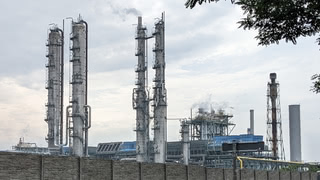
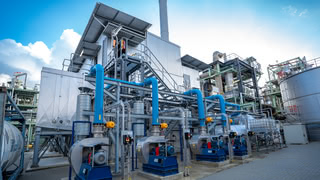
Through atmospheric measurements, scientists have identified a chemical factory operated by Solvay in Southern Germany as the source of massive amounts of Sulfur Hexafluoride (SF₆) emissions. Being 25,000 times as bad as CO₂, SF₆ is the most potent known greenhouse gas.
They knew something was not right. For years, scientists have warned that emissions of SF₆ (Sulfur Hexafluoride), the most potent greenhouse gas known to humanity, were higher than officially reported numbers.
Already in 2010, a scientific study compared atmospheric measurements of SF₆ with what countries reported, and noticed a large gap between the two. Multiple studies have since confirmed these findings. A recent study published in 2024 looked at emissions from the US, Europe, and China. In all cases, there is a significant gap between what countries reported and what the atmospheric measurements show.
It was, therefore, not a secret that there must be emission sources of SF₆ that were not part of the official statistics. But recently, an international team of scientists traced back some of these unknown emissions to a factory in Southern Germany.
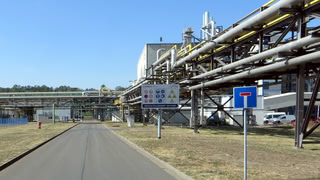
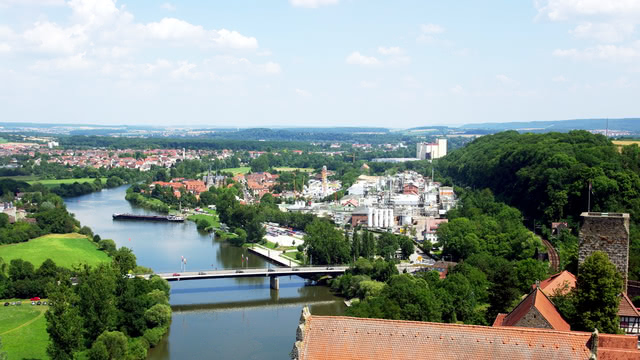
In Bad Wimpfen, the Belgian chemicals company Solvay operates Germany's only SF₆ production plant. In recent years, scientists discovered an unusual hotspot of SF₆ emissions in the area. Last week, the German magazine Der Spiegel and the public television station ZDF reported that there is little doubt that Solvay's factory is to blame for the high emissions. It was later also confirmed by the Ministry for the Environment of Baden-Württemberg, the state where the factory is located.
Solvay's factory reported only 56 kilograms of SF₆ emissions for 2023 to Germany's industrial emissions register. The scientist's estimates are 500 times higher: around 30 tons. Its effect on the atmosphere is more than that of 700,000 tons of CO₂ due to the high global warming potential of SF₆, comparable to a coal-fired power plant.
Nike shoes, Soundproof Windows, and Switchgear
Many fluorinated gases (F-Gases) have a high global warming potential. Often, these gases have a warming effect on the atmosphere several thousand times larger than CO₂. Even relatively small amounts emitted can have a large effect. Reducing or eliminating F-gas emissions, on the other hand, is often one of the cheapest ways to reduce negative climate impacts.
Of those F-Gases, none is more damaging than SF₆, the gas produced in Bad Wimpfen. Over a 100-year timeframe, the global warming potential of SF₆ is around 25,000 times that of CO₂. This has been known for a long time. In the second IPCC report, published in 1995, the 100-year global warming potential of SF₆ was listed as 23,900, pretty close to current estimates (25,200).
SF₆ has properties that make its use attractive in various industries. It is extremely inert, meaning it does not easily react with other substances, it does not burn, and it is not toxic. In the past, it has been used in applications as diverse as sports shoes, soundproof windows, magnesium manufacturing, and electric switchgear.
In 1989, Nike introduced its Air Pressure shoes. But its soles were not filled with air - they were filled with SF₆. According to media reports, the climate impact of Nike's shoes was first highlighted by a German magazine in 1992. (A reader pointed me to this report mentioning that the magazine was Stiftung Warentest's August 1992 issue. Another one of my readers contacted Stiftung Warentest and received a scan of the article from them.)
Nike would continue to use SF₆ in its shoes for 14 more years, until the company eventually replaced SF₆ with harmless nitrogen in 2006. (The story was not over, as Nike found itself later caught in a controversy about Carbon Credits from its SF₆-free shoes almost a decade later.)
While worldwide SF₆ emissions are still growing, in parts of the world, legislation has caught up and restricted or banned many uses of SF₆. The previously mentioned 2024 study highlights that this has been, to a certain degree, a success. While Europe's SF₆ emissions remain higher than reported, the scientists observed a significant drop in 2018 as a result of the EU's F-Gas regulation.
However, while you can no longer buy sports shoes containing SF₆, the gas still plays an important role in electricity grids. SF₆ is used in high-voltage electrical equipment as an insulator and due to its ability to prevent electric arcs.
The use of SF₆ in electric switchgear has sometimes been used by anti-renewable activists as an argument against wind energy. However, while it is true that the equipment connecting wind turbines to electricity grids contains SF₆, the same is true for any infrastructure that handles medium- to high-voltage electricity.
This use in switchgear is probably the main reason policymakers have been reluctant to swiftly ban SF₆. Even from a climate policy perspective, one can easily argue that banning or heavily restricting an important component of electric equipment may backfire. After all, electrification of polluting sectors is one of the most important decarbonization tools.
Particularly at the highest voltages, replacing SF₆ has been considered challenging. Replacement technologies can be more expensive, require more space, or entail other risks.
However, industry voices say equipment producers are ready to deliver SF₆-free switchgear. In 2023, nine producers of electric switchgear wrote a letter to the European Parliament lobbying for a phaseout of SF₆. The signatories included well-known names such as Siemens, Toshiba, Mitsubishi Electric, and Schneider Electric.
Under recently enacted EU regulation, use of SF₆ switchgear will be gradually phased out. However, SF₆ will still be part of the electricity infrastructure for a while, as existing equipment will still be serviced for decades to come. Minimising leaks and emissions remains crucial. The regulation also demands replacing virgin SF₆ production with recycled SF₆ gas.
Production of Ozone-depleting CFCs and Halons in the 90s
Solvay is a multinational producer of chemicals, headquartered in Belgium. It operates an SF₆ production plant at its chemical site in Bad Wimpfen in Southern Germany. (Solvay previously operated a second SF₆ plant in Onsan, South Korea. It was sold to the company KNW in 2021 and now operates under the name Fluorine Korea.)
In 1990, the chemical plant in Bad Wimpfen, then known as KALI-Chemie, was already under fire for producing dangerous gases. Greenpeace activists entered the chemical complex in a protest action, highlighting that it was, at the time, Germany's largest producer of Ozone-damaging substances like CFCs (Chlorofluorocarbons) and Halons. Eventually, production of those substances was phased out internationally under the Montreal Protocol, one of the great successes of international environmental policy.
Solvay's plant in Bad Wimpfen was at the core of another controversy more recently: the release of PFAS chemicals into the Neckar river. Solvay releases several tons of the "forever chemical" Trifluoroacetic Acid (TFA) per year. Solvay always emphasized that this was completely legal. Recently, however, Solvay announced that it will end TFA releases in Bad Wimpfen in 2026.
In 2020, scientists from the Goethe University in Frankfurt Main, Germany, first observed unusual SF₆ readings at the Taunus Observatory, an atmospheric measurement station. But it took some time until the scientists were sufficiently sure about their findings to raise the alarm bells. In 2023, they informed local authorities.
The Taunus Observatory is part of AGAGE, the Advanced Global Atmospheric Gases Experiment. AGAGE connects scientists and facilities worldwide. Their research contributes enormously to the knowledge about all the other greenhouse gases besides CO₂. If you want to learn, for example, what the atmospheric concentration of N₂O, Hydrogen, Sulfuryl Fluoride, or Dichloromethane is, AGAGE's web page is the place to find that information.
The same method has previously identified illegal CFC production plants
Measurements from AGAGE have previously contributed to the discovery of illegal CFC-11 production factories in China. CFC-11 is a cooling agent and an Ozone-depleting gas that is internationally banned under the Montreal Protocol. Subsequently, Chinese authorities reported later that they had destroyed multiple illegal CFC-11 production sites discovered due to these findings. This successful identification of illegal CFC production sites motivated the German Environmental Agency (UBA) to fund the SF₆ research.
In November 2025, Katharina Meixner from the Goethe University and 26 co-authors published their findings. They did not name Solvay directly, but mentioned this: "Further investigations revealed that the only factory currently producing and recycling SF₆ in Europe is located within the area where high emissions were estimated."
In early December, German public broadcaster ZDF and the magazine Spiegel published investigations about the SF₆ emissions and called out Solvay's factory in Bad Wimpfen as the likely source.
Shortly afterwards, the Ministry for the Environment in Baden-Württemberg, the state where the Solvay factory is located, published a public statement. The Ministry is led by the Green Party and was seemingly reacting to the public impression that authorities led by the Greens were not acting swiftly enough against an extreme emission source.
The statement cites regional president Susanne Bay, also a Green Party member, with the words: "The consultations with the company, the research team at the University of Frankfurt, and an independent testing institute have meanwhile shown almost beyond doubt that SF₆ was released at the Bad Wimpfen site to a drastically higher extent than what had been reported."
The authorities have ordered the company to lower its emissions to a certain limit. According to a fact sheet shared by the Ministry of the Environment, in September 2025, emissions were lowered by 86 percent, but were still above the limit. Solvay is now challenging the orders in court.
According to the Ministry, tackling the emissions was both legally and technically challenging. The emissions could not be traced back to a single leak, but were caused at multiple points in the complex chemical facility.
The Ministry also said that it is legally not possible to order a shutdown of the production facility. German law allows revoking the permit for a facility only if there is an immediate risk to human health or a significant immediate risk to the environment. While there is little doubt that greenhouse gases like SF₆ pose risks to the environment and human health, those are long-term.
Within the European Union, companies are required by law to report emissions to national emission registers. As mentioned, in 2023, Solvay reported only 56 kilograms of SF₆ to the national register, a tiny fraction of the estimated 30 tons. Between 2014 and 2022, Solvay reported exactly 60 kilograms of SF₆ emissions for most years, noting that this value was measured in the first year and calculated in subsequent years. For 2015 and 2020, there is no data about SF₆ emissions from the plant.
Implausible SF₆ emission data
Even without knowing the measurements of heightened emissions, this data looks implausible. I asked the German Environmental Agency (UBA) about these unusual data points. Companies only have to report emissions above certain thresholds. For SF₆, the threshold is 50 kilograms. This, to some degree, explains why certain years are missing. However, this does not explain the unusual reporting of the same value over multiple years. I also asked Solvay about these unusual data points, but have not received an answer.
It is not the only unusual finding of SF₆ emissions in public emission databases. The European data on industrial emissions includes an entry indicating that an Aluminium plant in Iceland, Norðurál Grundartangi, emitted 60 tons of SF₆ in 2011, but none in any other year. In all likelihood, this is a reporting error.
Furthermore, UBA informed me that Solvay has reported 310 kilograms of SF₆ emissions for 2024, which, at the time of writing this article, was not yet part of the public dataset. This raises further questions. While this is five times more than its previously reported emissions, it is still around a hundred times lower than the estimated 30 tons. At the time Solvay reported its 2024 emissions, the company was certainly aware of those findings.
(I learned about all of this while working on another investigation into data inconsistencies of public emission databases. You can find more information here and in a presentation at the 39C3 conference.)
The scientists' findings raise further questions beyond this single factory. Up until now, German statistics on SF₆ have assumed that the most important source of emissions is the destruction of old soundproof windows. The production of SF₆ was not considered a major emitter. It raises the question whether SF₆ factories in other countries have similar underreported emissions, and whether SF₆ production is a larger source of emissions than previously thought.
Update: I created a short video presentation: The Worst Greenhouse Gas on Planet Earth #SF6 (YouTube).
In collaboration with Jelle De Mey, I previously wrote about Solvay's SF₆ emissions for the Belgian publication Apache.be (in Dutch language).
Correction: The article originally claimed that Solvay operates an SF₆ production plant in South Korea. That was incorrect, Solvay sold that plant to the company KNW in 2021.
Author: Hanno Böck
Brief
-
An investigation by OCCRP indicates that a Romanian operator of coal power plants may have underreported carbon dioxide emissions from its power plants and thereby evaded the costs of EU CO₂ emission certificates.
-
Measurements at biogas plants in Denmark have shown high Methane emissions, with Methane losses of around 2.8 percent. (I previously covered biogas and biomethane production in Denmark quite favorably in the context of BECCS. I feel obliged to mention that not everything in Denmark's biogas industry is as green as it should be.)
-
C2X has announced an agreement with Microsoft about the sale of carbon removal credits. C2X, backed by A.P. Møller Maersk and A.P. Møeller Holding, is the majority owner of Sungas Renewables, which plans a biomass gasification and biomethanol plant in Pineville (Louisiana, USA). Biomass gasification generates CO₂ as a by-product, which makes it an obvious idea to combine it with BECCS and CO₂ removal. With a capacity of 500,000 tons annually, the Beaver Lake Renewable Energy project is the largest planned biomethanol project outside of China.
-
According to the Belgian publication "The Tijd", a biocoal plant in Dilsen-Stokkem, Belgium, was silently shut down in 2024. The plant was built by TorrCoal, which was later acquired by the company Perpetual Next. Perpetual Next and TorrCoal's previous owner also recently settled a legal dispute over the plant's quality and the acquisition. The Dilsen-Stokkem plant used the same torrefaction technology as the Torero project by ArcelorMittal that I covered previously.