Some of the cleanest Polyamide and Nylon precursor Factories are shutting down
The production of a chemical called Caprolactam results in significant N₂O emissions, a potent greenhouse gas. Most EU producers largely avoid these emissions. Some have made investments in drastic emission reduction in recent years. But many of these low-emitting factories are now shutting down.
In a specific subsector of the European chemical industry, a silent climate success story has been happening in recent years. Emissions from the production of Caprolactam, a chemical that is used to produce synthetic fibers (Nylon 6) and high-performance plastics (Polyamide 6), have been slashed in the European Union in recent years.
Caprolactam factories do not have high direct carbon dioxide emissions, but the production does cause significant amounts of N₂O, also known as Nitrous Oxide or Laughing Gas. It is the third-most important greenhouse gas and around 270 times as damaging to the climate as CO₂.
N₂O emissions from Caprolactam production within the European Union were at their peak in 2012, when the Caprolactam industry emitted around 7.3 thousand tons of N₂O. In 2023, those emissions had been reduced to 1.8 thousand tons, 75 percent less.
Due to N₂O's high global warming potential, this emission reduction is equivalent to avoiding 1.5 million tons of carbon dioxide annually, comparable to a medium-sized coal-fired power plant. Back in 2023, this reduction was not primarily caused by reduced production and plant closures, but by applying established, low-cost emission avoidance technology.
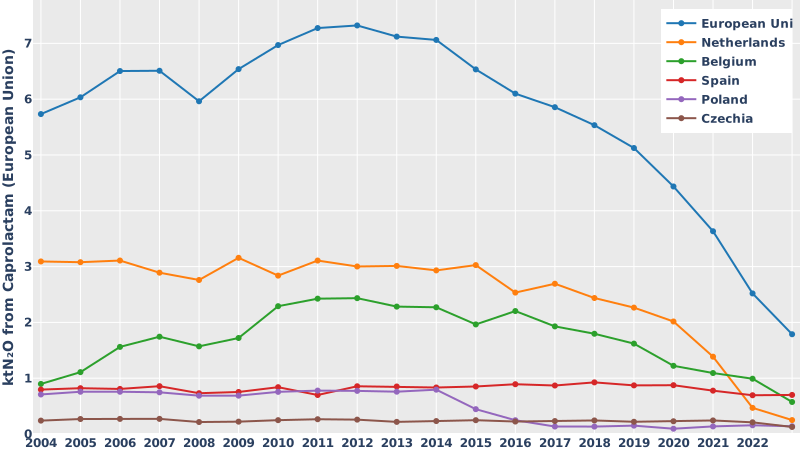
Two of the largest Caprolactam factories in the European Union, one operated by Envalior (previously Lanxess) in Antwerp, Belgium, and the other operated by Fibrant at the Chemelot industrial site in the Netherlands, have installed filtering technology that turns most of their N₂O emissions into harmless Oxygen and Nitrogen in recent years. Avoiding N₂O emissions in the chemical industry is one of the cheapest emission reduction options available.
Slashing EU emissions from Caprolactam production by 75 percent in a decade is certainly a success story. But it may have a bitter ending. Many of these factories that are amongst the lowest emitting in the world are now either already shut down or are under an immediate threat of being closed.
Plant closures in Germany, the Netherlands, and Czechia
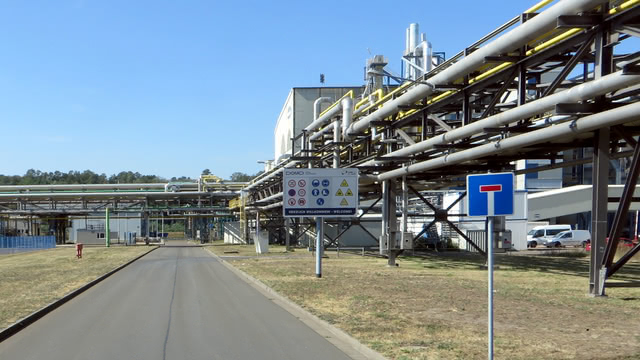
On December 25th, 2025, three German subsidiaries of the Belgian company DOMO filed for insolvency. One of them, DOMO Caproleuna, operates one of only two Caprolactam production plants in Germany. The plant is still operational due to an intervention by the local government to avoid an uncontrolled shutdown that could harm the facility, and a search for an investor to take over the plant is ongoing. But whether the plant has any future is, at this point, highly uncertain.
The other Caprolactam plant in Germany, owned by BASF in Ludwigshafen, was already shut down in 2023. Both German Caprolactam factories had negligible N₂O emissions.
Fibrant announced in October 2025 that it would close its plant at Chemelot in the Netherlands — the one that had just installed N₂O abatement technology in recent years.
Spolana in Czechia, a subsidiary of the oil company Orlen, announced the closure of a smaller Caprolactam production plant in early 2025. This one, however, was not among the cleaner ones. It was one of the few remaining Caprolactam plants in the EU without N₂O abatement.
The remaining largest emitter of N₂O in the European Caprolactam industry is a plant operated by the Japanese company UBE in Castellón, Spain. UBE operates Caprolactam production in Japan, Thailand, and Spain. However, UBE plans to end production in Japan and Thailand in 2027.
Unlike the plant in Spain, the Caprolactam production in Japan has quite low N₂O emissions. And UBE's plant in Thailand already had an agreement with the Nitric Acid Climate Action Group (NAGAC) for the funding of N₂O abatement technology. The NACAG is an initiative funded by the German government that supports N₂O abatement technology in developing countries.
The Caprolactam plant in Thailand once already had N₂O abatement technology, funded through an earlier international climate mechanism called the Clean Development Mechanism (CDM). However, that was later shut down, which was the fate of many such CDM projects. The NACAG is trying to avoid such unfortunate experiences by tying funding to commitments of countries and companies to permanently reduce their N₂O emissions. For UBE's Caprolactam plant in Thailand, that does not matter anymore, as it will be shut down.
The one plant UBE plans to keep running is the one in Spain. It is both the most polluting Caprolactam plant in the EU and would soon have been the most polluting within the company.
Two Caprolactam factories in Antwerp, Belgium, one operated by BASF, the other by Envalior, have not announced any plans for a closure. BASF uses a process that has no direct N₂O emissions to begin with. Envalior has installed abatement technology in recent years. Both plants in Antwerp have, therefore, very low N₂O emissions.
The situation of Azoty in Poland, another European Caprolactam producer, is less clear. The company owns two Caprolactam plants with very low emissions. Azoty announced a temporary shut down of Caprolactam production in August 2022 due to high fossil gas prices. Two months later, Azoty announced it had resumed production at one plant, while the other remained shut down. When I asked Azoty about the current status of these plants, the company did not directly answer and replied: "Production output of Caprolactam is adjusted to the current market demand in the Caprolactam–PA6 supply chain."
The outlook certainly looks dire for European Caproalctam producers. More than half of the production capacity within the EU will probably close, possibly even more.
Given the increasing burden of plastic pollution and health concerns about microplastics, some may understandably not shed too many tears over closures of plants that primarily produce a precursor to plastics. However, there is no indication that the economic difficulties of these plants are caused by a reduction in plastic consumption. Furthermore, Caprolactam-derived Polyamide 6 is only a very small share of total plastic production. The bulk comes from more commonly used polymers, such as Polyethylene or Polypropylene.
When European Caprolactam factories shut down, who will replace them? By far the largest producer of Caprolactam is China, followed by the United States. Production volumes are usually not publicly known, but we do have emission data from reports to the UNFCCC.
In 2022, the United States reported N₂O emissions from Caproalctam of around 5 thousand tons. That is around twice as high as those of the entire European Union, while the latter has many more production facilities. There are only two Caprolactam factories in the US, operated by BASF and AdvanSix. That clearly indicates that emission controls in the United States are lacking. Given the current political situation, that is unlikely to change any time soon.
China's last report to the UNFCCC indicates N₂O emissions from Caprolactam in 2021 of around 36 thousand tons. That is more than the entire rest of the world combined.
While N₂O emissions are the main direct emissions of Caprolactam factories, the total emission footprint furthermore depends on the production of precursor products and energy sources. In a blog post, Bert Havenith from Envalior, one of the Belgian Caprolactam producers, highlights that the full carbon footprint can differ significantly depending on factors like how electricity is produced or whether precursor products like Ammonia were made using coal gasification. According to Envalior, those differences are often not considered when calculating product carbon footprints.
I talked to Bert Havenith while researching this article. He confirmed to me that Envalior currently has no plans to shut down its production in Antwerp, because Caprolactam is an essential and critical part of Envalior's Polyamide 6 value chain.
Why is Caprolactam not part of the EU's Emission Trading System?
If Caprolactam production with low N₂O emissions in the European Union is shut down, it will, therefore, probably be replaced with a product with higher emissions.
It raises the question of what options exist to support struggling producers with low-emission factories. One of the core pillars of EU climate policy is the Emission Trading System (ETS). It is, in principle, based on a simple idea. Whoever emits should have to pay by buying emission certificates, giving those an economic advantage that emit less. However, in practice, it is an extremely complicated system with many gaps, loopholes, and inconsistencies.
A key limitation of the ETS is that it does not apply to all emission sources, but only to a selected list. Furthermore, in many cases, emitters get most of the emission allowances for free.
Since 2013, the ETS covers some N₂O emissions from the chemical industry, but not all of them. N₂O emissions from factories that produce Nitric Acid, a commonly used fertilizer, or Adipic Acid, a precursor of a different type of Nylon fibers, are covered by the ETS. However, N₂O emissions from Caprolactam are not. While Caprolactam producers in the EU largely avoid N₂O emissions, they gain little economic value from it.
Given that many of the factories facing closure are among the cleaner ones, one may ask whether that is a mistake and whether there are policy options to support climate-friendly production.
This may be a counterintuitive question to ask. The dire situation of the European chemical sector has led to calls by some industry leaders that blame European climate policy, with some extreme voices even calling for an abolishment of the European Emission Trading System.
Could the EU put a price on Caprolactam's emissions - and help cleaner producers?
However, simply adding N₂O from Caprolactam to the Emission Trading System would not necessarily change much. It would simply mean that Caprolactam producers who don't have any N₂O emissions to begin with wouldn't have to pay for them.
A key aspect of the existing Emission Trading System is that many industrial players get free allowances. This is done to address Carbon Leakage, the risk that production gets replaced with imports with a higher carbon footprint. However, these free allowances also undermine the emission reduction effect, and the EU plans to eventually replace them with a different system called CBAM. But before we get into that, it is worth having a detour to a story that played out in Switzerland a few years ago.
In 2017, the chemical company Lonza accidentally discovered that a factory in Visp, Switzerland, emitted large amounts of N₂O. The factory produces Niacin, also known as Vitamin B3, which is, for example, mixed into Energy drinks like Red Bull or used as an animal feed additive. (The factory has since been sold by Lonza and is operated by the company Arxada these days.)
Those emissions from that small factory were quite significant. They increased Switzerland's reported emmissions by around 1%.
Subsequently, Swiss authorities wondered how to legally address those emissions, as it was a case without a precedent. Switzerland is not part of the European Union. However, the country has its own Emission Trading System that is closely linked to the EU ETS. In effect, that means Switzerland usually tries to mimic EU regulation.
The Swiss environmental agency (Bundesamt für Umwelt, BAFU) commissioned two expert reports: one on the technical situation and the sources of the emissions, the other about the legal situation. The latter, written by the Fraunhofer ISI institute in Germany, addresses how these emissions from Niacin production would be treated within the European Union.
The Fraunhofer ISI report concludes that no factory producing Niacin exists within the EU, but it compares the situation to that of another product: Caprolactam, which, as mentioned earlier, is currently not covered by the EU's Emission Trading System.
The report discusses options for how emissions of such a factory could be addressed within the ETS framework. The ETS regulation allows that EU member states can unilaterally include additional processes (Article 24 of Directive 2009/29/EC). Such a national inclusion of processes emitting N₂O has been done before for Nitric Acid and Adipic Acid producers in some countries in the early phase of the ETS when they were not yet covered EU-wide.
Such an unilateral inclusion of an additional product would raise the question of whether the company that makes that product would have to buy its emission certificates or whether it would receive them for free. The latter is possible if they are at risk of Carbon Leakage of emissions due to international competition.
Taken together, we may wonder if this provides an opportunity for Caprolactam producers today. If a country were to include N₂O emissions from Caprolactam nationally and determine that there is a risk of Carbon Leakage, could it allocate free emission certificates to its Caprolactam producers? As they already avoid those emissions, they could sell the certificates and indirectly monetize their low emissions. It might be an option, but it would probably only work in a few cases.
Wolfram Jörß from the Öko-Institut in Germany, who co-authored a study on N₂O emission reduction potentials, told me that in such a case, the reference for allocating free allowances from 2026 onwards would be based on emissions in the years 2019 to 2023, multiplied by a decreasing factor. Jörß also pointed out that this would raise the question of whether this would inflate the total number of emission allowances, which could lead to emission increases in other industrial sectors.
This option would therefore not help producers in countries where emissions were already eliminated a long time ago, like in Germany. However, it could temporarily help Caprolactam producers in countries where emissions have been reduced in recent years, like Belgium or the Netherlands.
What about fully including Caprolactam N₂O emissions into the ETS in the whole European Union? That would give the clean producers an advantage over those with high emissions. Given that there is only one small Caprolactam facility with high emissions left, the impact would be limited. The main issue is that the cleaner Caprolactam factories face competition from outside Europe.
In the long run, the European Union plans to phase out the system of free allowances and replace them with a policy called the Carbon Border Adjustment Mechanism (CBAM). The key idea is to extend the Emission Trading System to imported goods. CBAM is currently in its early stages, and the European Union plans to only include a few basic materials in the first phase. CBAM also comes with many complexities, and many in the chemical industry are not exactly fans of the instrument.
Including complex downstream products like Caprolactam in CBAM is unlikely to happen in the near future.
As Bert Havenith from Envalior explained to me, for the desired effect of helping cleaner producers would also require including downstream products like Polyamide 6. Caprolactam is usually not shipped over long distances, imports tend to be those downstream products. If those are not covered, CBAM would be ineffective.
"In principle, CBAM is a good system to address different greenhouse gas emissions," Havenith said. "We would prefer that CBAM is extended towards Caprolactam, Polyamide 6 polymers, and Polyamide 6 compounds on the condition that it is not made too complicated and complex by extending it to further multi-material applications, components, and systems downstream."
CBAM could help cleaner Caproalctam producers in the long run, but it is not a quick fix. However, it may still make sense to pursue it. It could signal to plant owners and potential investors that their clean production process will give them an edge in the future. Given that CBAM is built on top of the Emission Trading System, any plans to include Caprolactam in CBAM would have to start with first including Caprolactam in the ETS.
Of course, there is no guarantee that CBAM would save struggling Caprolactam factories in the European Union. While many Chinese producers currently have relatively high emissions, the country has plans to address these emissions. In October 2025, the responsible Chinese ministries released an "Action Plan for Nitrous Oxide Emission Control in the Industrial Sector".
How could fossil-free Caprolactam production look like?
Avoiding direct N₂O emissions from Caprolactam production has a major impact. Nevertheless, even those cleaner factories with little to no N₂O emissions rely on fossil fuel feedstocks. It is worth asking how a future fossil-free Caprolactam factory could look.
The production process for Caprolactam is relatively complex, involving many feedstocks and intermediate steps. But, broadly speaking, there are a few important fossil input materials in the process: Ammonia, Hydrogen, Sulfuric Acid, and, depending on the exact process, either Phenol or Benzene. (Phenol is also made from Benzene.)
Hydrogen can be produced via electrolysis of water using green electricity, and Ammonia is the main product made from Hydrogen. How to clean up those is, therefore, relatively obvious, although not necessarily cheap.
It is less clear what a pathway for green Benzene or Phenol would look like. Regular readers of my newsletter will know that green Methanol, which could be made from biomass and waste gasification, through CO₂ utilization, or with a combination of those options, could serve as a feedstock for future green chemicals. A process called Methanol-to-Olefins is the most promising fossil-free pathway for common types of plastics.
However, the situation for Caprolactam and its downstream products, like Polyamide 6, is different, as they are not based on Olefins. Benzene and Phenol belong to a group of chemicals called Aromatics. A Methanol-to-Aromatics process exists, but unlike Methanol-to-Olefins, it has only been used in small pilot facilities and not on an industrial scale.
Some are exploring other pathways. A startup called BioBTX in the Netherlands is working on waste- and bio-based Aromatics production pathways.
I discussed this with Philipp Hauser, an independent expert and consultant on climate-smart forestry and industrial carbon management. He points out that one potential route to green phenol and other aromatics could lie in trees.
"Lignin, a main structural component of wood, can serve as a feedstock for the production of aromatic compounds, including phenol, through pyrolytic and catalytic biorefinery pathways applied to woody biomass or isolated lignin," said Philipp Hauser. "In practice, however, selectively converting heterogeneous lignin streams into defined molecules at competitive cost remains challenging, and these processes are still at an early stage of development."
Lignin is a common by-product in the pulp and paper industry and is predominantly burned on-site to generate process heat and power. Replacing part of that heat generation with electrified solutions, such as heat pumps, and using lignin as a chemical feedstock is an attractive idea.
It is worth pointing out that the DOMO Caprolactam plant in Leuna, which has recently faced economic challenges, now has a new neighbour that may be relevant in this context. UPM has started production at its wood-based biorefinery in Leuna. Lignine is a co-product of UPM's processes.
"While this would require significant technological progress and incentives to compete with fossil-based routes, the regional co-location of biorefineries and existing chemical infrastructure opens up a credible long-term perspective for developing climate-neutral industrial value chains," Hauser said.
Another fossil resource used during Caprolactam production is Sulfuric Acid made from Sulfur. While Caprolactam itself contains no Sulphur, its production creates Ammonium Sulfate as a co-product, which is used as a fertilizer.
As Peter Ruschhaupt, an analyst from the climate think tank Future Cleantech Architects (FCA), explained to me, historically, Sulphur has been mined with a method called the Frasch process. However, that has largely been replaced with Sulfur from oil refineries. It would be an option to go back to Sulfur mining and the Frasch process in a post-fossil world, but it would likely be more expensive.
It is, at this point, not obvious how the process for a green, fossil-free Caprolactam, Polyamide 6, and Nylon 6 production would look. However, their use in consumer products like sportswear has the potential for a significant green premium. A bold investor might see relatively clean, but economically struggling Caprolactam factories being shut down as an opportunity to explore such pathways.
Update: I created a video about N₂O emissions.
Author: Hanno Böck
Brief
-
Shanghai Huayi Industrial Gases inaugurated a green Methanol plant utilizing urban waste with an annual capacity of 100,000 tons (English translation of the announcement). According to the announcement, construction was completed within a year. (That's another one than the Biomethanol plant in China mentioned in the last newsletter. They're building these things fast.)
-
Vioneo, a fossil-free plastics company that originally wanted to build it first plant in Belgium, has now announced a change of plan and wants to build it in China, citing the proximity of green Methanol supply. I covered Vioneo's plans and interviewed their CEO last year.
-
A study commissioned by the environmental NGO NABU raises important questions about LNG-powered ships. LNG (Liquefied "Natural" Gas) permanently creates boil-off gas: as there is no perfect insulation, some of the liquid will always revert to the gaseous state. Ships usually burn this boil-off gas in their engines. However, while in harbor, it is best practice for ships to switch off their engines to avoid air pollution and to receive electricity from the grid. This land-based electricity will also be regulated in the EU soon. This creates a problem for LNG ships: they can no longer burn their boil-off gas in the engines.
-
An analysis by Global Energy Monitor indicates that the AI datacenter boom in the United States will largely be powered by fossil gas, often relying on inefficient behind-the-meter generation.
-
Norsk E-Fuel and Outokumpu have signed a Memorandum of Understanding for the construction of a plant producing aviation fuel from the gases created as a by-product of Outokumpu's Ferrochrome production. It raises the question whether that should be called "sustainable" aviation fuel (SAF), as the carbon source is indirectly still coal. It could, however, become an attractive solution if it is combined with biogenic carbon. (Outokumpu had announced an investment in a biochar plant in Germany in 2024.)
-
A plant to produce jet fuel using waste gasification called Green Birch, to be built in Umeå, Sweden, has been announced. Umeå is also the location of a planned E-Methanol plant by Liquid Wind, a mixed waste sorting plant, and a potential CCS/BECCS project, all with involvement from Umeå Energi, operator of the local waste incineration plant. (See also my thoughts on LinkedIn.)