Why China Is Winning the Green Methanol Race
Methanol made from sustainable feedstocks is a key technology for climate-neutral shipping, aviation, and fossil-free chemicals. Chinese companies are already building industrial production facilities and surrounding infrastructure, while the rest of the world is falling behind.
These days, it is safe to assume that the future energy system will be dominated by solar energy. The technology for this future energy system is largely built in one country. The nine largest manufacturers of solar photovoltaic modules are all based in China. Similar developments occurred in other key cleantech sectors, such as wind turbines or batteries.
These examples are well known. A future climate-neutral industry will require many other technologies that are, these days, in early stages. Renewable energy, electrification, and batteries will be the dominant solutions to replace fossil fuels in the future. But in sectors like long-distance shipping, aviation, or the production of carbon-based products like plastics, it is difficult or impossible to replace fossil fuels directly with electricity. Green Methanol made from fossil-free feedstocks could play a key role in these sectors.
Methanol is a carbon-containing liquid with the chemical formula CH₃OH. Currently, it is primarily used as a feedstock in the chemical industry. Today's Methanol production is, however, largely based on fossil fuels. Most Methanol is made from fossil gas. A smaller, but still significant share is produced through coal gasification, primarily in China.
"Green" Methanol made from sustainable biomass, Hydrogen, CO₂, or, with some caveats, unrecyclable waste has gained some momentum in recent years. This was, initially, largely driven by interest from the shipping industry to use Methanol as a fuel, and is often connected with the name Maersk. The world's second-largest shipping company and its parent company, A.P. Møller Holding, invested in multiple startups working on Green Methanol technology.
Green Methanol could also serve as a fossil-free feedstock for other industries. Methanol-to-Olefins technology can be used for the production of polymers and plastics. The closely related Methanol-to-Jet technology is a promising option to produce advanced biofuels, e-fuels, or a combination of both for aviation. Methanol is relatively easy to store and could serve as a seasonal or multi-year backup energy source.
The idea that Methanol production could be made "green" and that it could, thereby, serve as a replacement for fossil fuels, is often attributed to the Nobel laureate George Olah, who coined the term Methanol Economy in 2005.
Some of Olah's ideas appear outdated these days. Olah could not foresee the rapid development of battery technology that makes some of his ideas — like powering laptops with Methanol fuel cells — look more like curiosities. The term "Methanol Economy", coined by Olah as an alternative to the already popular "Hydrogen Economy" concept, implies a broad application of Methanol technology that appears unlikely these days. Nevertheless, Olah had a lasting impact.
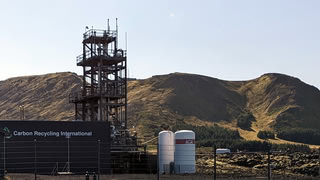
In 2012, a small startup in Iceland inaugurated the George Olah Renewable Methanol plant. Carbon Recycling International had built a first pilot to implement the technology Olah had envisioned: using Hydrogen to turn Carbon Dioxide into Methanol. George Olah, who died in 2017, participated in the opening ceremony.
With a production capacity of around 4,000 tons annually, the George Olah Renewable Methanol plant is a small pilot. But Carbon Recycling International wanted to upscale its technology quickly. Already in 2011, Carbon Recycling International and Iceland's largest electricity producer, Landsvirkjun, had plans for a plant with a capacity of 80,000 tons annually. However, those plans never materialized.
They could not upscale in Iceland and went to China
In 2015, the Chinese carmaker Geely became an investor in Carbon Recycling International. That opened the door to the Chinese market.
"Geely Group and Carbon Recycling International intend to collaborate on the deployment of renewable Methanol fuel production technology in China and explore the development and deployment of 100% Methanol-fuelled vehicles in China, Iceland, and other countries," the two companies wrote back in 2015. "The companies share a vision for a larger role for Methanol as a clean and sustainable fuel in China, Europe, and the world."
Geely is the largest producer of Methanol-powered cars, which have a certain market share in China. However, this initially had little to do with Methanol being a "clean and sustainable fuel".
China has limited access to oil and gas resources, but the country has vast domestic coal resources. This led to the development of various technologies that utilize coal, many of which involve Methanol. Coal gasification, which turns coal into syngas and, subsequently, often into Methanol, is widely used in China. The most important use of Methanol from coal gasification is the production of plastics through the Methanol-to-Olefins process.
The overall emission footprint of coal gasification is higher than that of alternatives based on oil and gas. There certainly is some irony in the fact that some of these technologies are both an enabler of high-emitting coal technologies and a promising climate solution.
In 2022, a decade after the inauguration of its pilot plant in Iceland, the first industrial-scale plant using Carbon Recycling International's technology began production in Shunli in China's Anyang province, utilizing off-gases from a coke production facility. A second plant was inaugurated a year later alongside a coal-based Methanol-to-Olefins plant, operated by Jinagsu Sailboat.
Although these plants do reduce emissions compared to coal-based Methanol production, neither of these plants is, by any reasonable definition of the word, a "Green" Methanol plant. They utilize Hydrogen created as a by-product of fossil-fuel-based processes. Nevertheless, it is certainly noteworthy that Chinese companies, including one of the largest coal-to-chemicals players, are showing an interest in this technology.
Is combined Bio-E-Methanol the smartest move?
Making Methanol from CO₂ and green Hydrogen is often described as E-Methanol, as it is a way of turning electric energy into a liquid energy carrier. This approach, which is part of a set of technologies known as Carbon Capture and Utilization (CCU), comes, however, with severe disadvantages.
CO₂ is a low-energy molecule. Turning it into a high-energy molecule like Methanol inevitably requires enormous amounts of external energy in the form of Hydrogen.
A 2017 study published in the scientific journal PNAS estimated that converting the world's chemical industry to CCU- and Methanol-based processes would require between 17 and 32 petawatt-hours of electricity annually. To put that in perspective: the world's total electricity generation is around 30 petawatt-hours.
Furthermore, any CCU process raises questions about its CO₂ source. Utilizing CO₂ from fossil or otherwise geological sources is incompatible with climate neutrality. If Methanol is later used, directly or indirectly, as a fuel, the carbon will still eventually end up in the atmosphere. Therefore, CCU will eventually have to rely on either biogenic CO₂ sources or direct air capture, with the latter being prohibitively expensive.
Various pathways allow the production of Methanol from biomass. The standard fossil-fuel-based production process for Methanol uses fossil gas. It is first converted into syngas, a mix of Hydrogen and Carbon Monoxide. Syngas is the basis of Methanol synthesis.
The same process can be operated with Biomethane made from Biogas. However, as a drop-in replacement for fossil gas, Biomethane has many potential uses, and the sustainable production potential is limited. Biomethanol production pathways that can utilize a wider range of biogenic sources are, therefore, desirable.
A key technology that could enable the use of more diverse biogenic resources is gasification. Under high temperatures, biogenic materials can be broken down into simpler molecules. After proper gas cleaning, this gasification can also produce syngas. From there, the existing Methanol synthesis process can be used. This biomass gasification is similar to the already mentioned coal gasification technology.
Biomass gasification is considered a promising pathway for advanced biofuels that would eliminate the land-use concerns and often enormous indirect emissions associated with traditional biofuels. It could enable the use of widely available cellulosic biomass, such as straw or wood.
Similar gasification processes could also utilize mixed waste. Waste gasification is one of a set of technologies known as chemical recycling that promise to turn otherwise unrecyclable waste back into valuable chemicals.
However, these gasification technologies are challenging to operate, particularly if one aims to use the resulting syngas for subsequent conversion steps. There is a long history of failed waste and biomass gasification projects.
A significant number of waste gasification facilities exist in Japan, but, for the most part, they burn the resulting syngas. The challenging part, however, is cleaning the gas sufficiently to allow the synthesis of chemicals like Methanol.
A rare exception, besides many failed waste and biomass gasification projects, was a Waste-to-Methanol plant in Germany that ran between 1995 and 2007. The technology worked, though with the caveat that it mixed some coal into its waste, something that would probably no longer be acceptable today. The facility, SVZ Schwarze Pumpe, operated reliably for multiple years but was eventually unable to compete with virgin Methanol.
Whether one uses Biogas or biomass gasification, CO₂ is created in both cases. E-Methanol requires a source of CO₂, which, ideally, should come from biogenic sources. Taking this together, an obvious idea emerges: by adding additional Hydrogen, one can create a hybrid of Bio- and E-Methanol in a single process. In the case of mixed waste, we could call it a mix of circular, Bio-, and E-Methanol.
In 2021, the International Renewable Energy Agency (IRENA) published a report about Renewable Methanol that prominently featured such combined Bio-E-Methanol processes.
The Green Methanol Megafactories in China
In 2023 and 2024, announcements for Green Methanol projects in China started appearing. While Green Methanol projects were announced around the world, and particularly in Europe, those from China were different — both in their scale and in the chosen technologies.
Europe was planning Green Methanol plants with annual capacities in the tens of thousands of tons. Chinese announcements ranged from hundreds of thousands to millions. Scaling up makes a lot of sense. Methanol is a chemical process that benefits a lot from scale. If you want to make it cheap, make it big.
Europe was primarily planning E-Methanol plants, which, in all likelihood, is the most expensive pathway. In China, the focus was on Biomethanol or hybrid Bio-E-Methanol projects.
Chinese companies did not just announce Green Methanol production plants; they started building them. Towngas, a company based in Hong Kong, and Shenergy are operating a Methanol plant utilizing mixed waste and biomass since 2023 in Ordos, Inner Mongolia. It has a capacity of 100,000 tons annually. Not as much as some of the larger announcements, but still significantly larger than anything comparable anywhere else in the world.
In mid-2025, Shanghai Electric inaugurated the world's first industrial Bio-E-Methanol plant using biomass gasification enhanced with Hydrogen. It has an initial production capacity of 50,000 tons, with a 200,000 ton scale-up planned until 2027. The Swiss chemicals company Clariant provided on-site support during the start-up of the plant and is Shanghai Electric's Methanol catalyst supplier.
Impressive Biomass Gasification Ramp-Up by CMIC ENRIC
Two more Green Methanol plants started production in late 2025: Shanghai Huayi Industrial Gas with a 100,000-ton Biomethanol plant using Biomethane from anaerobic digestion, and CIMC ENRIC with a 50,000-ton Biomethanol plant using biomass gasification.
I recently spoke with Eric Matsgård, the CEO of Braathens Renavia, a Swedish developer of Sustainable Aviation Fuel projects. Braathens Renavia wants to utilize gasification technology, so naturally, they are interested in how this technology is performing elsewhere. In December 2025, Eric Matsgård visited multiple gasification projects in China, including CMIC ENRIC's recently inaugurated biomass gasification plant.
"What struck me most was the ramp-up. Within less than two months from start-up, the facility had already reached around 60–70% of nameplate capacity", Eric Matsgård wrote after the visit. If this is true — and there is little reason to doubt that — it is hard to overstate how remarkable that is.
It is normal for new chemical plants, even if they use established and well-understood technology, to require a significant start-up phase that can take many months where unexpected problems are addressed until they operate as expected. Operating a biomass gasification plant, a technology known to be challenging with a history of failures, at a high capacity just two months after start-up indicates exceptionally good engineering.
Four Green Methanol plants with different technological approaches are now operational in China. Each of them is larger than anything comparable that exists anywhere else in the world.
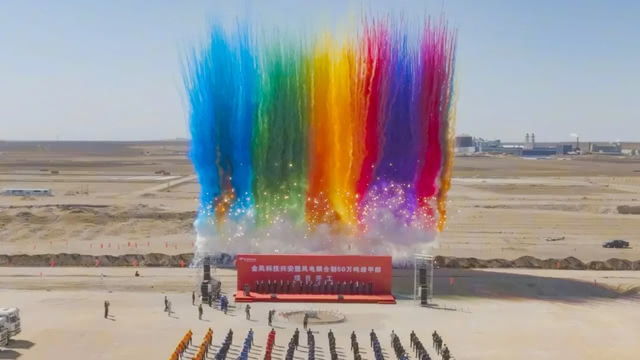
Some even larger projects have not announced a production start yet, but are under construction. Wind energy company Goldwind announced the construction start of a 500,000-ton combined Bio-E-Methanol plant in 2024. Solar company LONGi started building a plant in 2025, targeting 190,000 tons in its first phase and 400,000 tons when fully built out.
However, not all early announcements are being realized. Back in 2023, carmaker Geely also announced plans for massive Green Methanol plants. A first plant was already under construction, but Geely stopped it in 2025 without much explanation.
Many international shipping companies have entered off-take agreements with Chinese Green Methanol producers. Happag Lloyd and Maersk have off-take agreements for combined Bio-E-Methanol with Goldwind. CMA CGM will buy Methanol from Shanghai Electric.
The rest of the world is falling behind
How is the production of Green Methanol doing elsewhere? The renewable energy company European Energy inaugurated an E-Methanol plant with an annual capacity of 42,000 tons in Kassø, Denmark, in 2025. Its off-takers include Maersk, Lego, and Novo Nordisk.
That's it.
European Energy's Kassø PtX project is the only operational Green Methanol plant of any meaningful size outside China.
European Energy also realized that a combined Bio-E-Methanol process is a good idea, although they are not betting on gasification. In October 2025, the company announced plans for future Green Methanol plants based on Biogas enhanced with Hydrogen using electric steam methane reforming (e-SMR) technology.
There is no shortage of Green Methanol projects being announced in Europe, North America, and elsewhere. Yet, few of them are making meaningful progress.
One that reached a final investment decision was Flagship One, an E-Methanol plant originally planned by the company Liquid Wind and later acquired by the Danish energy company Ørsted. Ørsted announced the final investment decision in 2022 and broke ground in 2023. In August 2024, however, Ørsted cancelled Flagship One.
While Ørsted has not shared many details about its decision, it appears its plans were in part derailed by a lack of ambition from the European Union in its FuelEU Maritime regulation. In the meantime, Liquid Wind, the company that originally started the project and later sold it to Ørsted, announced plans to resume it and build it even larger.
In Canada, a consortium involving Shell, Suncor, and Proman — a major producer of fossil-fuel-based Methanol — was building a project named Recyclage Carbone Varennes, a Waste-to-Methanol plant yield-enhanced with Hydrogen, with gasification technology from the company Enerkem. A similar project with Enerkem's technology was planned in Rotterdam in the Netherlands, involving Shell and the chemical companies Akzo Nobel and Air Liquide, but construction never started.
After cost increases and an unwillingness from Proman to provide additional funding, the project in Varennes collapsed. Enerkem now hopes to build another such plant with Repsol in Spain, named Ecoplanta. The remains of Recyclage Carbone Varennes were sold to a company named StormFisher Hydrogen, which wants to build a pure E-Methanol plant instead. I covered Enerkem's projects in detail in a previous newsletter.
The largest announced Green Methanol project outside China is Beaver Lake Biofuels in the United States. It targets a production capacity of 500,000 tons of Biomethanol using gasification technology from SunGas Renewables. The project is developed by C2X, a company founded by A.P. Møller Holding, the majority owner of Maersk. C2X plans to combine Biomethanol production with carbon removal by permanently storing the resulting CO₂.
Beaver Lake Biofuels has not announced a final investment decision yet. Construction start is planned for the second half of 2026.
Carbon Recycling International, the Icelandic company that pioneered E-Methanol, wanted to build a larger plant in Norway in collaboration with the company Finnfjord, a producer of Ferrosilicon. This project, originally announced in 2020, was recently removed from the list of projects on Carbon Recycling International's website.
I asked Carbon Recycling International about it, and they informed me that the project has not been cancelled. "Some development work is still ongoing," wrote Gunndís Eva Reykdal Baldursdóttir from Carbon Recycling International. "Carbon Recycling International received development assistance from the EU Innovation Fund to further mature the project, but the timeline and whether it will ultimately move forward remain uncertain at this stage."
In the meantime, Carbon Recycling International is busy developing more projects in China. Its first large-scale Green E-Methanol plant, in collaboration with Tianying, is under construction. "The project with Tianying Group is progressing, and the current expectation is that the plant will start up in the second half of this year," according to Carbon Recycling International's spokesperson Baldursdóttir. "It is fair to say that China has been moving quickly in scaling new energy and fuel technologies, including Methanol. In other regions, projects often move more slowly due to different regulatory frameworks, funding structures, and market conditions."
The collaboration between Carbon Recycling International and Tianying is among the few "pure" E-Methanol projects in China. However, the company that pioneered E-Methanol long before anyone else is also getting involved in hybrid Bio-E-Methanol plants. In August 2025, Carbon Recycling International announced a cooperation agreement with Jilin Huajin Energy for the Yushu Green Methanol Project, a planned gasification and Bio-E-Methanol plant with a capacity of 270,000 tons annually.
A Pipeline Grid for Renewable Methanol
Many of the larger Green Methanol production plants in China are not located close to the coast. This creates challenges. Transporting Methanol by truck or train is possible, but it adds costs and emissions.
A planned pipeline grid could link many of these production sites with the coast. These plans are in early stages; a feasibility study was announced in March 2025. This project involves multiple pipelines for Hydrogen and its derivatives, Ammonia and Methanol.
For fundamental physical reasons, transporting Hydrogen is difficult and costly. If the goal is to make Hydrogen derivatives, which is the case most of the time, transporting the derivative product is more sensible.
Three legs of this pipeline grid with a combined length of around 1,700 kilometers would be dedicated to renewable Methanol.
The Finnish cleantech analytics company Gena tracks global Green Methanol projects closely. In a LinkedIn post, Gena's CEO, Vitalii Protasov, wrote that around 5 million tons of planned Green Methanol production capacity in China's Inner Mongolia province and further production plants in Jilin province are located close to these potential Methanol pipelines.
Converting Coal Assets to Sustainable Aviation Fuel Plants
As mentioned earlier, the widespread use of Methanol is nothing new for China's industry. Methanol was and is a way to utilize coal gasification. This certainly creates a complicated story. China is rushing ahead with clean technologies, but its own economy is still largely reliant on the dirtiest of the dirty fossil fuels.
However, this close connection between dirty coal and future green technologies has implications, as it gives Chinese companies some advantages.
While the gasification of coal, biomass, or waste is not the same — gasifying coal is considered the easiest, while mixed waste is the most challenging — the technologies are closely related.
It is likely that this helps Chinese biomass gasification projects. In a country that operates the world's largest coal gasification industry, it should be easier to find qualified engineers to run biomass gasification plants.
Beyond engineering skills and experience, the similarities between existing coal-based and future green technologies create the possibility of reusing existing coal assets.
Methanol-based technology is a promising pathway to make sustainable aviation fuels, relying on the mentioned Methanol-to-Olefins process. Olefins are the building blocks of common types of plastics, the most important one being Ethylene. Through additional conversion steps, Ethylene can serve as the basis for synthetic Kerosene. This pathway is also known as Methanol-to-Jet technology.
The chemical industry is currently struggling with overcapacity, leading, for example, to the closure of many steam crackers in Europe. However, the oversupply is global, and Chinese Methanol-to-Olefins plants are facing similar challenges. Cleantech analyst Vitalii Protasov told me that two Chinese Methanol-to-Olefins producers have plans to repurpose their existing assets for the production of sustainable aviation fuels.
It could have been an Icon for a Future beyond Oil and Gas for Europe
In September 2024, A.P. Møller Holding, the parent company of shipping giant Maersk, announced a bold plan: a fossil-free plastics plant in Antwerp, Belgium, one of Europe's largest chemical industry clusters.
A.P. Møller Holding created the startup Vioneo to implement this plan. Maersk has, as mentioned, been pushing the idea of Green Methanol as a future shipping fuel. But this marked a new development. Its owner company was asking whether it could use this technology to enable cleantech solutions in an entirely different industry. Vioneo wanted to use the same Methanol-to-Olefins technology that is used in China to make plastics from coal, but feed it with Green Methanol.
That Methanol-to-Olefins is a promising technology for fossil-free chemicals and plastics was not a new idea. However, this was the first time that a real investment into such a pathway was on the horizon.
Notably, this plan did not come from any of the large players in the chemical industry. This is part of a larger pattern. The traditional chemical companies in Europe have invested very little in the technologies that would prepare them for a future beyond oil and gas.
Vioneo was not alone in announcing such a project. The startup BlueCircle Olefins wants to build a Methanol-to-Olefins plant in Rotterdam (Netherlands). However, unlike Vioneo, it is an independent startup and not backed by a large corporation.
Vioneo's plant in Antwerp could have been a prime example for Europe's industrial transition towards a chemical industry beyond oil and gas. In January 2026, however, Vioneo announced a change of plans: "Vioneo remains strongly committed to bringing fossil-free plastics to market. As such, it is proceeding with a more effectual production plant, located in China near Green Methanol supply, as its first commercial-scale facility."
It seems very likely that the world's first fossil-free plastics plant will be built in China. Europe lost a massive opportunity.
According to an article by the Dutch news site Industrielinqs, Vioneo applied for the EU Innovation Fund in 2024 with the project in Antwerp. The Innovation Fund is one of the most important support instruments in the European Union for large-scale cleantech projects. However, Vioneo was initially not among the selected projects. It was, however, on a reserve list and added later after other projects had fallen off.
When Vioneo received the offer for the Innovation Fund grant, the company had already decided to move its first project to China. While it is one of six projects the European Commission announced recently for the Innovation Fund, Vioneo's spokesperson Judy Hicks told Industrielinqs that the company will stick to its plans to build in China and will, therefore, not accept the EU grant money.
While the EU's decision to initially not select Vioneo's project appears incredibly short-sighted, it was probably not the main reason the project in Antwerp did not materialize. According to Industrielinqs, Vioneo's Judy Hicks said that it was not the decisive factor and part of a broader decision. In their own press release, Vioneo highlighted the "proximity to green methanol supply" in China.
Even before Vioneo announced its plans to build in China rather than in Europe, the company had publicly stated that it would initially not source its Green Methanol from Europe and would rather purchase Biomethanol from Asia. Of course, that is unsurprising. With barely any Green Methanol production capacity in Europe, where should they buy it?
I talked to Vioneo's CEO, Alex Hogan, in early 2025. (I tried to interview Alex Hoagan again for this text, but he has not replied to my messages.)
Back in 2025, Alex Hogan told me he would prefer a European supply chain and that he had been in discussions with the European Commission about stimulating Green Methanol supply in Europe. Hogan also said that, at the time, he considered Repsol's Ecoplanta to be the only "real" project of any meaningful size in Europe.
"I can't talk to a serious developer about buying Methanol, whether E or Bio, yet," the Vioneo CEO said back then. "Which is a shame, because Europe has huge amounts of biomass with which we can produce Biomethanol, which would be a perfect supply chain for us."
Vioneo was already planning to source its Green Methanol from outside Europe, and it does not look like Europe will catch up soon. The decision to build its facility in a country where four Green Methanol production plants are already operational and many more are under construction is, to say the least, unsurprising.
A Compounding Failure for Europe's Cleantech Future
It is a compounding failure for Europe's cleantech future. While there is certainly no shortage of announced Green Methanol production projects in Europe, few of them appear to make any progress, and only one facility, the Kassø PtX project by European Energy, is operational. Europe's failure to kickstart a Green Methanol production industry leads to a failure to attract innovative downstream businesses like Vioneo, which seeks to utilize Green Methanol for a premium market willing to pay for fossil-free alternatives.
Let me finish this with some personal thoughts: I have no issue with the cleantech solutions we will need in the future being built in China. I much prefer Chinese players building them over not having them at all. I would just prefer that they were not the only ones; that Europe and the rest of the world would also build them.
In times where climate policy is under attack, watching these developments makes me think that there are powerful strategists in China who believe that there is a future where we will use these technologies at scale, even though they target "hard-to-abate" sectors and will likely be, at least for a while, more expensive than their fossil-fuel competitors. Chinese players are preparing themselves for a future where Green Methanol plays a key role. The rest of the world should take note and act accordingly.
I wanted to end this text with a brief analysis of why Green Methanol in Europe is not progressing. However, it quickly became clear that the analysis would not be "brief". To give you a sneak peak, here are some of my notes and key aspects: missed early opportunities, a lack of scale-up, a focus on expensive technologies like E-Methanol and post-combustion carbon capture, an unstable policy environment punishing first movers, a failure to recognize the importance of cellulosic biomass and the recognition of fraud-prone feedstocks as "advanced" biofuels, and a worrying lack of interest and investment in clean technologies by Europe's existing chemical industry. I covered some of these aspects in a followup newsletter about E-Methanol.
Author: Hanno Böck
Elsewhere
Brief
-
A first shipment of CO₂ from Biogas generated by a wastewater treatment plant in Norway was sent to the Northern Lights storage site. In a previous newsletter, I explained why Biogas and Biomethane upgrading with CCS are a promising combination.
-
A battery-powered freight ferry operated by Scandlines, the Baltic Whale, has been put into service and connects Puttgarden in Germany with Rødby in Denmark.
-
This post by Paul Martin about CO₂ Utilization is worth reading.